Fabrement
Our own WordPress plugin and MCP server
WordPress plugin development for our own team: 7Fridays built Fabrement, a WordPress plugin with an MCP server for every site, so the AI agent you already pay for, ChatGPT, Claude, Codex or Cursor, can build WordPress sites properly. We use it in our client work every day. The website you are reading went from a Figma design to live in 2 hours, plus 4 hours of fixes: 6 hours in all. By hand, before AI, it would have taken at least 120 hours; with AI tools alone, about 60.
Until 2025 we built every site by hand, on our own theme. In spring 2025 we started testing AI, and from the summer it was part of our daily development work. To learn on, we built two tools for ourselves: our own task manager in autumn and winter 2025, and our own hosting control panel in winter and spring 2026. One part of our work stayed slow: turning a custom design into a clean, fast WordPress layout. Models were getting good enough to do it, but nothing stopped them from writing code that breaks a site.
So a team of four built a place for the agent to work, with checks it cannot skip. Version 1.0.0 shipped on 1 April 2026; version 1.7.0, the 13th release, followed on 3 November 2026. The plugin is free; the product lives at fabrement.com.
Website: fabrement.com
- Year
- 1.0 in April 2026, 1.7 in November 2026
- Team
- 4 people
- What we built
- WordPress plugin, MCP server, backend, 5 companion plugins
- Works with
- ChatGPT, Claude, Codex, Cursor
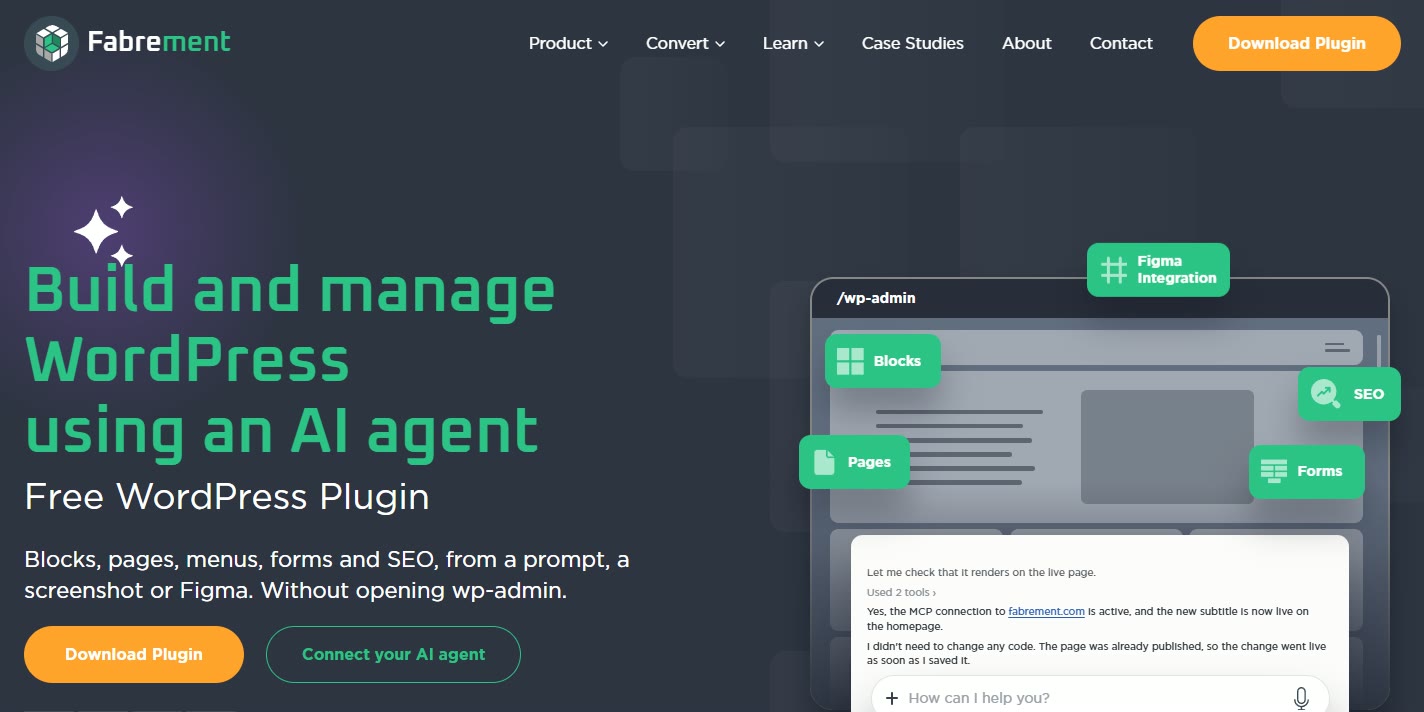
How the plugin works: tools, rules and walls
How the plugin works
Fabrement is not an AI agent. You bring the agent you already pay for, and Fabrement is where it works on your WordPress site.
Tools
Through MCP the agent builds blocks, headers and footers, pages, menus, forms, post types, SEO settings and the design system.
Why it matters
One connection does the whole site, not one feature.
Rules
Before it changes anything, the agent reads the guide for that area and the site’s design system: its colours, fonts and buttons.
Why it matters
New pages look like the rest of the site, not like generic AI output.
Walls
Every piece of code is checked before it is saved. If it fails, the agent gets a list of what is wrong and fixes it. It cannot load outside scripts, and it can install only a short list of plugins. Every change is a version you can roll back, and publishing is a separate step.
Why it matters
We don’t ask the model to be careful; we check what it produces. So any model works.
The walls at work
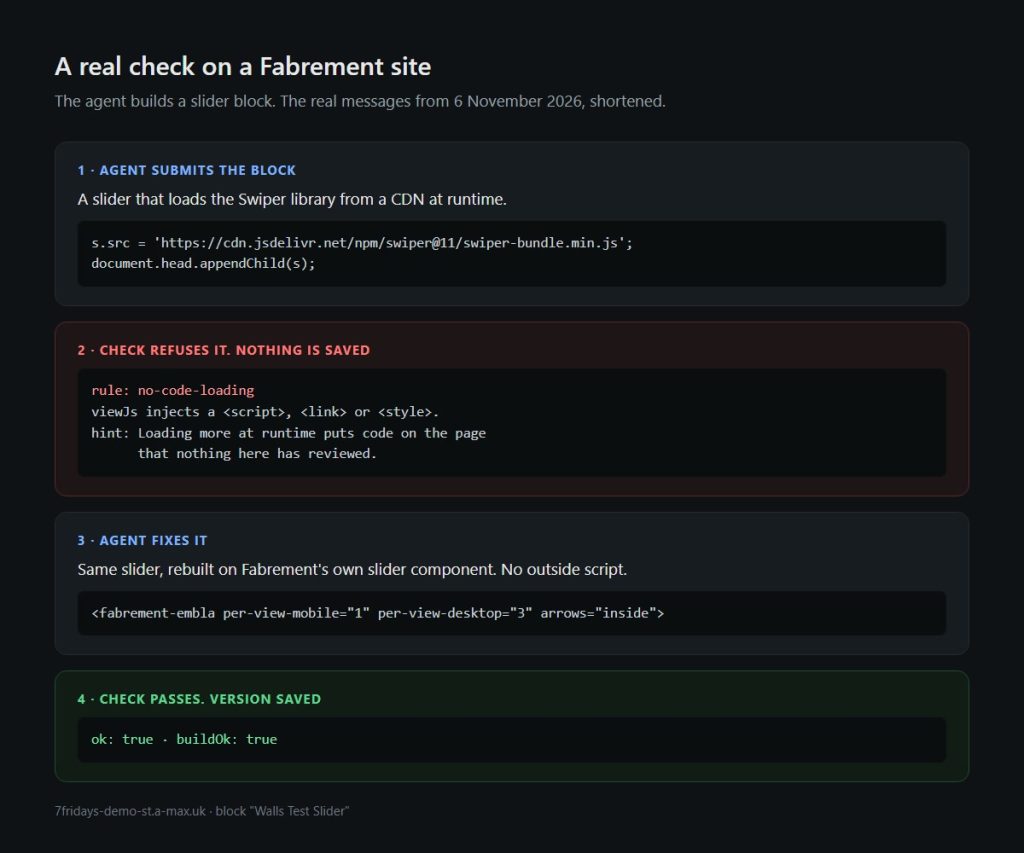
A real check, 6 November 2026
We asked the agent to build a slider block on this site and let it reach for a familiar shortcut: load the Swiper library from a CDN while the page runs. The check refused it under the rule no-code-loading, and nothing was saved. Code loaded that way would land on the page without anyone having reviewed it.
The agent read the reason, rebuilt the same slider on Fabrement's own slider component, with no outside script, and the next version passed and was saved. The model did not have to know the rule in advance; the check told it, and it fixed the code.
Fabrement in numbers
November 2026
- 6 hours
- this website from Figma to live: 60 with AI alone, 120+ by hand
- 13
- releases since April 2026
- 100+
- installations
- 117
- MCP abilities an agent can use on a site
Cowboy Productions
12 hoursfrom a Lovable design to WordPress
After the handover, the owner built a multi-step form himself, through his own AI agent, with no developer.
Client sites built with Fabrement
Proof outside our own team
A doctor's website
< 2 hoursfrom one image and his social pages
Built from one image and his Facebook and Instagram pages, then changed in plain words at his request.
Impact Negotiation Group
4languages, run by the owners
Our first client site built with Fabrement: a four-language WPML site that its owners run through their own AI agent. Lumick, a fourth client, moved from Elementor to native blocks with the same design and SEO.
Oleg transformed our Lovable website to WordPress in the cleanest and most efficient way. The best solution out there!
From our own tools to a plugin
2025 to today
-
2025: learning on our own tools
Spring 2025: first AI tests; from summer, daily use. Then our own task manager and hosting panel to learn on.
-
1 April 2026: version 1.0
Custom Gutenberg blocks from Figma, a screenshot or a text description, with every block’s code checked.
-
July 2026: our own site
We start building fabrement.com with it, then client sites, the first for Impact Negotiation Group.
-
3 November 2026: version 1.7
Thirteen releases in seven months, used in our client work every day.
WordPress plugin development
Questions, answered from this project
Can you build a custom WordPress plugin like this for us?
Yes. Fabrement is a WordPress plugin, an MCP server and a backend, and we build custom plugins and AI integrations for clients the same way, with the same checks on the code.
How long does custom WordPress plugin development take?
It depends on what the plugin does. Fabrement is a large one: version 1.0 shipped on 1 April 2026, and version 1.7, the 13th release, on 3 November 2026, built by four people alongside client work. A plugin for one job on one site, such as a payments or booking integration, is far smaller, and we estimate it after seeing the brief.
How long did it take to build this website with Fabrement?
Our 7Fridays site went from a Figma design to live in 2 hours, plus 4 hours of fixes: 6 hours in all. By hand, before AI, it would have taken at least 120 hours, and with AI tools alone about 60. How much AI speeds work up depends on the kind of work and the tools: AI alone halved this job, and Fabrement cut it about twentyfold.
Who built Fabrement?
Four people at 7Fridays: Andrian, our tech lead, Oleg, Roman and Max, the same team that builds our client sites. We learned on two tools of our own first, a task manager and a hosting control panel, then built Fabrement and released version 1.0 on 1 April 2026.
Is Fabrement an AI agent?
No. It is the workplace for your AI agent. The agent is ChatGPT, Claude, Codex or Cursor; Fabrement gives it the tools, the rules and the checks to work on WordPress.
Do you use it on client projects?
Yes, every day. Impact Negotiation Group was the first client site built with it, then Cowboy Productions, a doctor's website and Lumick, moved from Elementor to native blocks.
Does the client need to pay you every month to keep editing?
No. The plugin and the MCP connection are free. The client pays for their own AI plan and hosting, and edits the site through their own agent.
More custom software projects
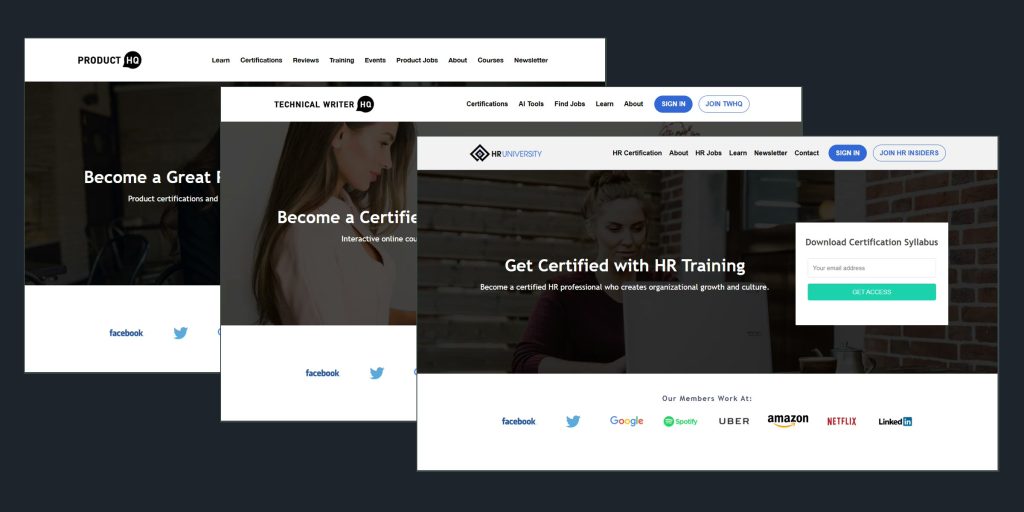
HR University, Technical Writer HQ and Product HQ
Theme development for three career-education websites, built with performance in mind: close to 1,000 articles, 25+ certification courses, Stripe payments, and 99% of URLs passing Core Web Vitals on mobile.
This is Madeira Island
A car rental marketplace for Madeira: 9 rental companies connected by API in one booking system, with payments, cancellations and refunds handled automatically.
WordPress as a platform for Software
WordPress serves as a platform for developing a wide range of projects, including software. Here are some examples of the benefits you receive for your business when using this platform
Let's make something meaningful
Tell us what you are building. A real engineer replies within one working day — usually with questions, sometimes with a first estimate.
Talk to us
Tell us what you are building. A real engineer replies within one working day — usually with questions, sometimes with a first estimate.