Lead Service
Lead generation websites for Norway and Sweden
7Fridays maintained and grew a network of 10 lead generation websites for Lead Service in Norway and Sweden, from 2023 to 2026: Next.js sites on headless WordPress, and the admin system that sends every lead to paying partners.
Lead Service runs comparison sites where people ask for offers from estate agents, lawyers, builders, accountants, heat pump installers and other local providers. Every site is a funnel: a visitor fills in a form, the lead lands in the central admin system, and from there it goes to partners by email or straight into their CRM.
We took over four running portals and kept them producing leads while we redesigned and extended them, built two new sites from scratch, and extended the admin system behind all of them. That came to around 2,000 commits across the sites, the API and the admin.
Every site is a Next.js front end on Vercel. WordPress runs headless and holds only content: editors build pages from blocks, and Yoast handles SEO. When an editor publishes, WordPress tells Next.js, and the change goes live without a full rebuild.
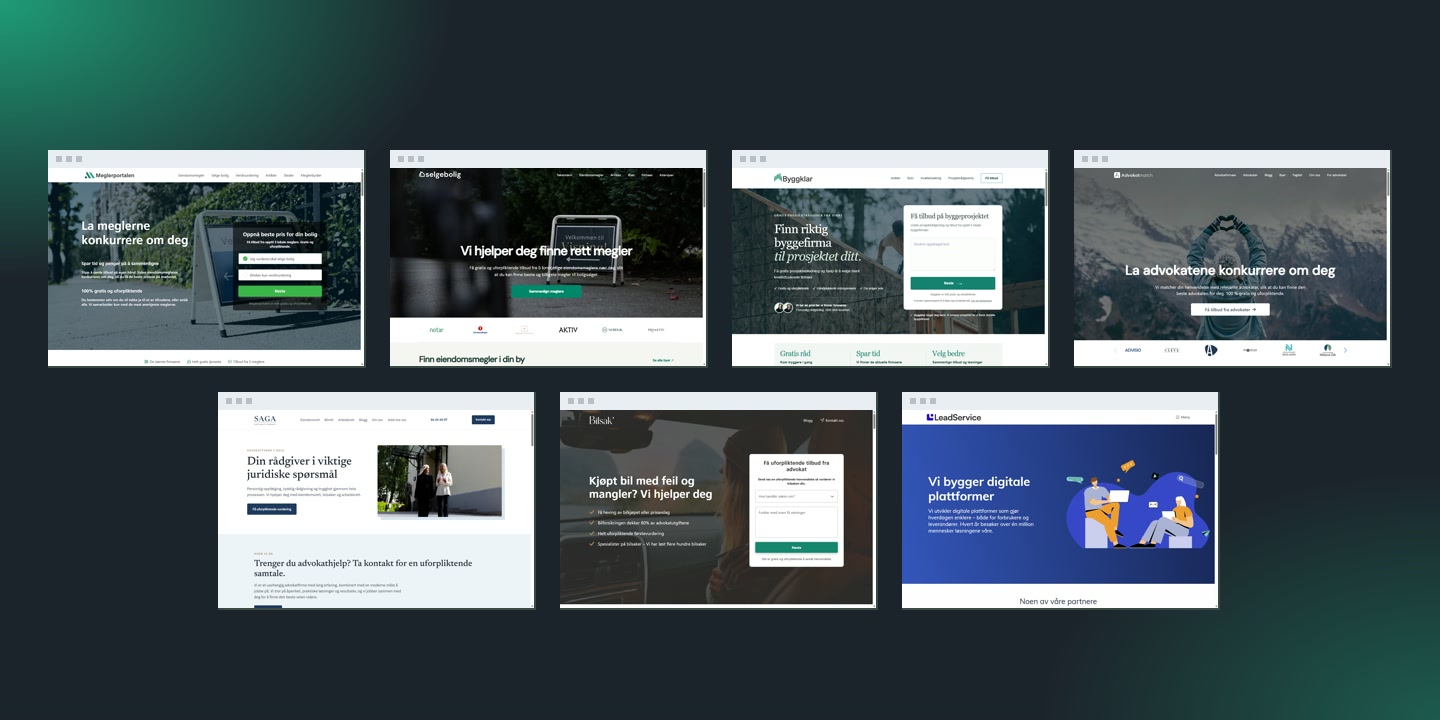
Websites: meglerportalen.no, selgebolig.no, byggklar.no, advokatmatch.no, sagaadvokat.no, bilsak.no, leadservice.no
- Client
- Lead Service AS
- Industry
- Lead generation, Norway and Sweden
- Years
- 2023 to 2026
- What we did
- 10 sites, lead API, admin system
Lead admin for the business
What the team runs the network with
Behind the sites sits one admin system: it receives every lead, matches it to partners, and shows what each ad and landing page earned.
Partner matching by postcode
Leads are matched to partners by postcode, region and category, and delivered by email or straight into the partner’s CRM. We added the Swedish market: about 19,000 postcodes, layered by region and municipality, with bulk select.
Why it matters
One admin serves both countries and all 15 business sectors.
Every lead traced to its ad
UTM, gclid, gbraid and wbraid are captured on the forms and stored on every estate agent lead, and the API returns a real lead ID, so analytics events match real leads. An hourly job writes earnings and lead counts per landing page to Google Sheets.
Why it matters
Ad money goes where confirmed leads come from.
Split tests on confirmed leads
Each visitor keeps one variant. A variant counts a conversion only when the admin system confirms the lead, and a private dashboard shows conversion rate, significance and the mobile and desktop split.
Why it matters
Tests are decided on leads partners actually receive, not on form clicks.
The network
2023 to September 2026
- 10
- lead generation sites in Norway and Sweden
- 15
- business sectors in one admin system
- 451
- leads to estate agents in September 2026 alone
- 3 months
- for two new sites, from first commit to live
When the CMS became the bottleneck
The hard part of a growing headless network
Headless WordPress gives editors freedom, but every page Next.js builds is a request to WordPress. The sites kept growing: hundreds of city guides, agent and lawyer profiles, and landing pages. Eventually WordPress began protecting itself with rate limits and timeouts, and production builds failed halfway. When a build fails, nothing ships: not a new landing page for an ad campaign, and not an urgent fix.
The worst case was on meglerportalen.no. Opening the city overview made the browser prefetch all 64 city links at once, and one page view turned into about 190 parallel WordPress requests. A simple query took 11 seconds instead of 0.75, and 52 of the 64 city pages came back as errors. Loading city pages on click instead of in advance fixed that page. The rest we treated as one problem with one fix, applied to every site.
The repair also uncovered hidden SEO damage on advokatmatch.no. WordPress returns at most 1,000 results per query, so every lawyer profile past the first 1,000 was missing from the sitemap, and old lawyer URLs no longer redirected. Both are fixed, and the full directory is back in search.
Four fixes, applied to every site
Builds deploy reliably again
-
Back off when WordPress says stop
On a too-many-requests answer, the data layer waits as long as WordPress asks and retries with growing pauses. Reads retry on brief server errors; writes never do.
-
Send fewer requests at once
We limited build workers and parallel page generation on four sites, and cut duplicate queries, such as a second SEO request for every page.
-
Build heavy pages on purpose
On meglerportalen, published city articles are now built before deployment, at a pace the CMS can handle, instead of all at once or on the fly.
-
Don't wait on what is known
Routes the site already knows no longer wait on a CMS lookup, which also fixed a redirect loop on selgebolig.
Lead generation website development on Next.js and WordPress
Questions, answered from this project
Can headless WordPress handle a large Next.js site?
Yes, if the site respects its limits. On this network WordPress feeds hundreds of pages to six main Next.js sites. Once builds sent too many requests at once, WordPress answered with rate limits and timeouts. Backing off on its signals, sending fewer requests at once and prebuilding heavy pages at a steady pace made builds reliable again.
Can you take over an existing Next.js and WordPress project?
Yes. We took over four running portals and kept them producing leads while we updated, redesigned and extended them, without a rewrite. That included moving from Next.js 13 to 14 and applying the December 2025 React and Next.js security patches.
How are leads matched to partners?
Each form sends the lead with its site and sector to a central API. The admin system matches it to partners by postcode, region and category, and delivers it by email or straight into the partner's CRM. A copy goes to Google Sheets for reporting.
How long does lead generation website development take?
On this project, two new lead generation websites, sagaadvokat.no and bilsak.no, went from first commit in late August 2025 to live in about three months. Both are fully CMS-driven, so editors build pages without a developer.
How do you know which ad produced a lead?
The forms capture UTM, gclid, gbraid and wbraid, and every estate agent lead stores them in the admin system. The API returns the new lead's ID, so analytics events match real leads, and split tests count only leads the admin system confirms.
Can the business use its lead data without touching production?
Yes. We built a read-only lead export API and a partner overview API, with paging, JSON and CSV export and incremental sync, documented with OpenAPI. The business runs its own dashboards from them.
More Next.js and WordPress projects
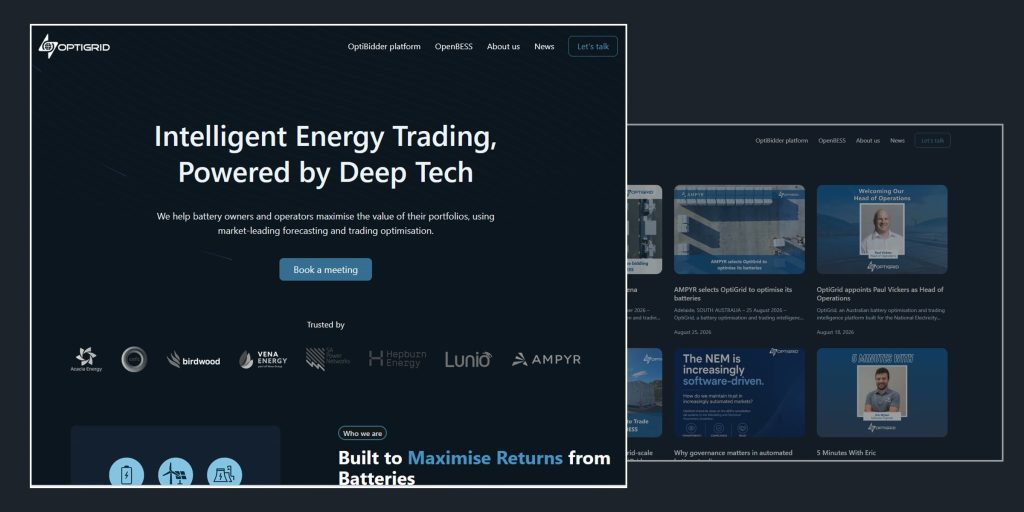
OptiGrid
A Next.js CMS for OptiGrid: WordPress as a headless CMS behind their Next.js website, so the team publishes news and edits pages itself, with SEO managed in Yoast.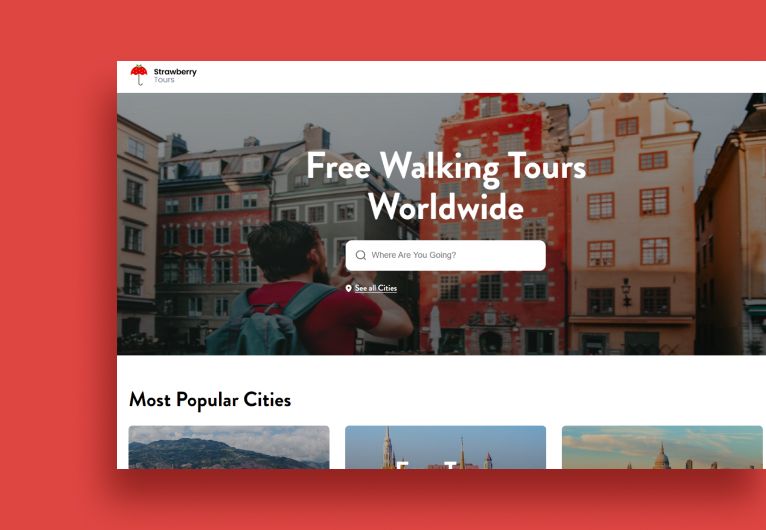
Strawberry Tours
A tour booking platform with a portal where guides run their tours and their business, while travellers book free walking tours in cities around the world.
Artificial Intelligence and Search Optimization in Headless Projects
Modern digital ecosystems demand extreme flexibility from businesses, making the transition to Headless architecture a standard for companies striving for scalability and high-speed interfaces.
Let's make something meaningful
Tell us what you are building. A real engineer replies within one working day — usually with questions, sometimes with a first estimate.
Talk to us
Tell us what you are building. A real engineer replies within one working day — usually with questions, sometimes with a first estimate.